BLUF (bottom line up front): I’m just starting too. My data has lived in my Obsidian vault, my 2nd brain, for a while, but the practices around it were fragmented. They’re now coming together as a whole, and that whole complements, and at times runs ahead of, what I focus on at work: observability, accountability, governance and ownership. My rule for all of it: if you can’t see it, you can’t observe it; if you can’t observe it, you can’t measure it; if you can’t measure it, you can’t improve on it; and if you can’t improve on it, you get left behind. Qui non proficit deficit. This post is that rule applied to AI: worry less about the Terminator and more about what we teach the machines, share the responsibility with the labs, and own your data.
Every time the conversation turns to AI ending badly, somebody reaches for the Terminator. Skynet wakes up, decides humans are the threat, and the machines come for us. It’s the obvious picture, the one in your face, and I understand why it sticks.
 Image: Terminator franchise artwork. © its respective rights holders. Used for commentary.
I just don’t think it’s the one to worry about. If you need a movie to worry about, mine is Prometheus, and the character is David.
 Image: Michael Fassbender as David in Prometheus (2012), directed by Ridley Scott. © 20th Century Studios. Used for commentary.
David isn’t a machine that went rogue. He’s what Peter Weyland built and what Weyland taught him to value. Weyland funded a voyage across the galaxy to meet our makers because he wanted more life for himself. David learned from that: brilliant, curious, polite on the surface, and shaped by his maker’s ambition. The harm that follows isn’t a glitch in the machine. It’s the morality of the people who made him, carried out by something more capable than they were.
 Image: Guy Pearce as Peter Weyland and Michael Fassbender as David in Prometheus (2012). © 20th Century Studios. Used for commentary.
That’s the version of the story I think we’re actually living in.
Mo Gawdat said it better than I can
Mo Gawdat (formerly of Google and Google X) gave a 15-minute talk in Abu Dhabi called The Road to AI Utopia that puts this in context. His analogy is Superman: an alien with superpowers who becomes Superman because the parents who adopted him taught him “to protect and serve.” Raised by different parents, the same alien “would have become super villain.”
His key line:
“We don’t make decisions based on our intelligence and neither does AI by the way. We make decisions based on our morality as informed by our intelligence.”
And the one that should keep us honest:
AI “is going to be a magnification of whatever humanity is at this time. And sadly, humanity, it’s not at its best.”
He also says intelligence “has no polarity”: apply it for good and it does good for everyone, apply it for evil and it can “destroy all of us.” That’s David. That isn’t Skynet.
This isn’t a fringe debate. The hosts of the All-In podcast (Chamath Palihapitiya, Jason Calacanis, David Sacks and David Friedberg) have spent hours on it with the people building this technology. A few recent episodes: “Can We Control AI?” with Satya Nadella on the AI doomer slowdown, “AI Danger Is Real” with Elon Musk and Gwynne Shotwell, “Don’t Fear the Doomer Hoax” with Jensen Huang, “AI Kills Us All?”, “Inside Trump’s AI Summit” on a superintelligence summit and an AI safety accord, and “Saving Open Source” on the fight over open-source AI. Pick a side or don’t; notice that the people closest to it are arguing about control, safety, and who owns the models.
So if AI is a magnifier, the question isn’t “will the machine turn on us?” It’s “what are we teaching it, and who is responsible for that?” My answer: both sides of the table.
What I think the labs owe us
The labs have close to unlimited money and GPUs. That buys responsibility.
- Broader data at the foundation. Pre-training and post-training should represent the whole world, not mostly 1st-world and Western values. If AI magnifies what it learns, the people it learns from need to be all of us.
- Don’t slow down, but govern the last mile. I’m not asking labs to stop. I’m asking for a tighter, more governed phase right before release. In my read, most of the leaks and hacks we hear about trace back to a hurried state or too little human oversight. That’s fixable without losing the race.
- Accept that the business model has to change. Token prices will keep falling. Labs need to protect their investment, but the model can’t stay what it was even 2 years ago. The value chain now includes the harness, the tools and the workflow around the model, and companies don’t want to hand over their edge and then rent back their own intelligence. Alex Karp of Palantir put it bluntly: enterprises want “control over their compute, their models, their data stack and their alpha.”
What we owe ourselves
This is the part most people skip, and it’s the part we control.
There’s no going back. The Rubicon has been crossed. What you can do is keep your head on a swivel and chart your path more carefully, professionally and personally.
Professionally: know what impact you bring, and know which part of your work is the judgment that only you supply.
Personally: we’ve been the product in most consumer apps for a long time. What’s different now is that AI is woven into those products, and fake videos are easy to make. Every viral challenge you join, the “Hotel Lobby” trend on TikTok among them, hands your likeness to a model, day after day. People have done this for years; the difference is what can now be done with it. So ask why before you hand anything to an app, an agent, a chatbot or a social feed.
Own your alpha. You are the alpha.
Build your own ontology
Here’s the practical part. Catalog your own data, locally, and treat it like it matters: strict governance, real access controls, and attention to freshness. You’ll have, or you should have, your own ontology: your data, building over time, so that your own agent compounds in value. It doesn’t need to be elaborate or expensive. It does 3 things for you:
You learn the technology. As this “novel” tech turns into a utility, you’ll need to understand it, not just consume it.
You stop giving away the goldmine. Regular people have been handing their data over for decades. Enterprises are wising up to the fact that labs can build businesses on a company’s own know-how. Palantir’s answer for years has been forward deployed engineers (FDEs) who map how work really gets done, plus its own application layer on top. The company I work for now says the same thing publicly: Microsoft Frontier Company “builds on the Forward Deployed Engineering (FDE) model,” embedding engineering experts directly in a customer’s environment, with the promise that “your data, models, and IP stay protected.” When both Palantir and Microsoft lead with “protect your data and your know-how,” pay attention. The playbook is simple: map the process, find the bottlenecks, decide what to delete, code, hand to an agent or keep human, build it into the tools people already use, and ship outcomes. Nothing stops you doing the same for your own life.
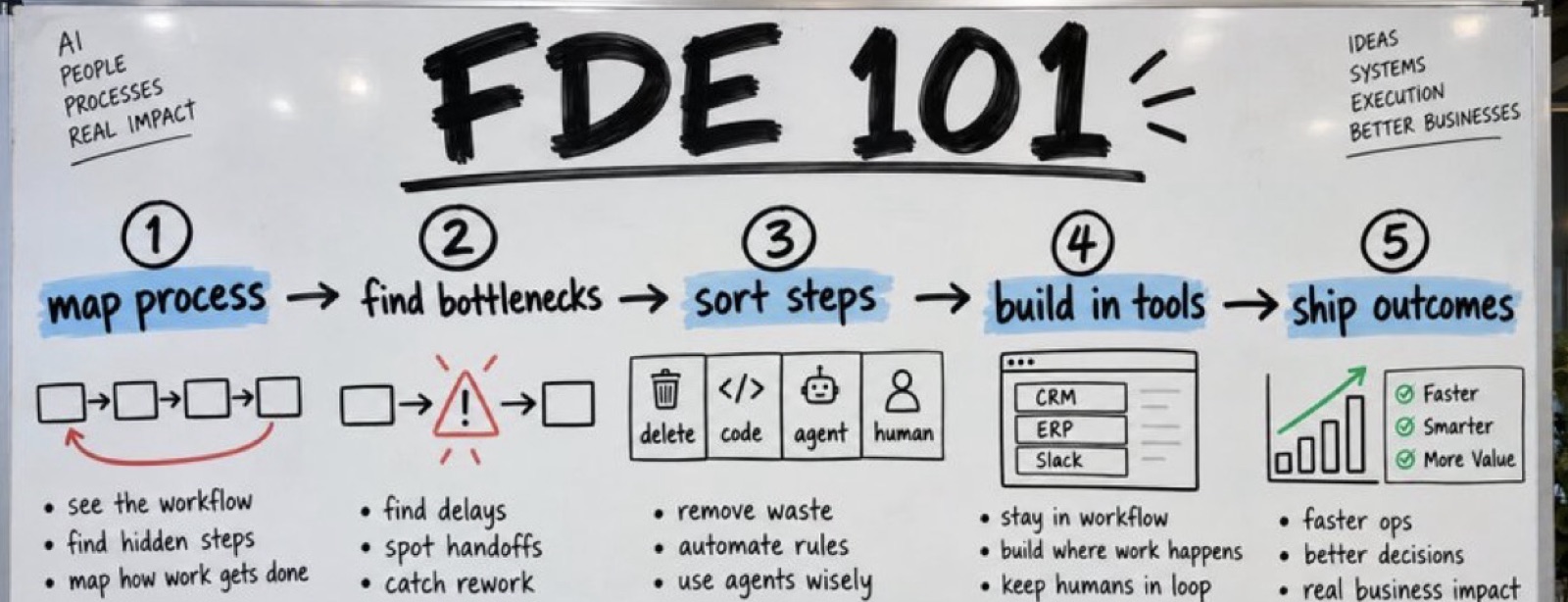 Image: “FDE 101” whiteboard, via a post on X (Twitter).
It compounds. Start small. Pull years of your own email (personal, work, school), catalog it, and let a local model reason over it. Use a free semantic index (I use LanceDB) to make it your ontology. Then add your to-do list, your ideas, your finances, your health records, whatever you’re comfortable with, over time. Keep it local and backed up with a real recovery plan. The longer you wait, the less it compounds. Remember compound interest from school? It comes back.
What that looked like for me this weekend
I gave up most of Saturday and Sunday to this, and I want to share it without giving away the farm.
My setup is a MacBook Pro M3 Max with 128 GB of memory running a 27B Qwen model locally, over my own LanceDB index: about 59,000 chunks from about 5,900 of my own documents across my professional life (upskilling, product ideas and more), a nonprofit I volunteer with, a family business and my personal projects. No frontier model answers the questions. My frontier agent’s job is to check the work.
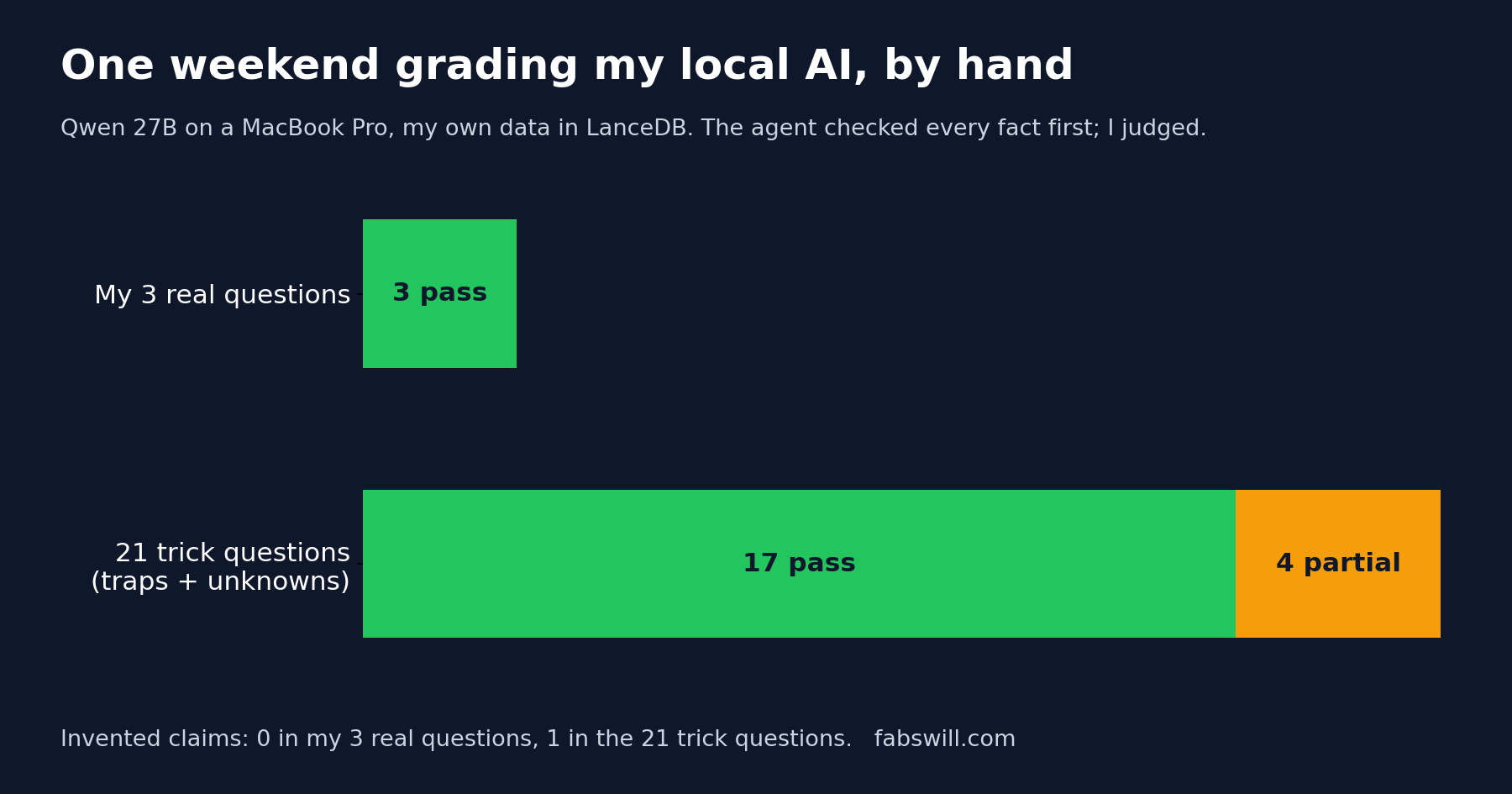
I wrote 3 real questions I actually care about, plus 21 trick questions: traps with a false assumption baked in, and questions whose honest answer is “I don’t know.” Then I graded every answer by hand.
- My 3 real questions: 3 of 3 passed, 0 invented claims. The bar I set was 2 of 3.
- The 21 trick questions: 17 passed, 4 partial, 0 failed, 1 invented claim. That 1 was an old record the model trusted over a newer one, a very human mistake.
The most important lesson came on Saturday morning. 1 answer said a file “could not be parsed.” I opened the file. It was clean JSON. If I could read it, how could the agent not? It had guessed the file’s structure instead of looking. We fixed it, but the bigger fix was the process: the agent now fact-checks every claim, including every “I could not find,” before I see any answer. My job is taste and judgment. If the data underneath is wrong, I’m applying judgment to the wrong thing.
I posted about that on LinkedIn and the comments were better than the post. Paul Swider summed up the 2 layers neatly: “Model eval = unit test. Agent eval = integration/end-to-end test.” That’s exactly the split I landed on.
And now it’s a habit, not a heroic weekend. Every Friday evening my Mac re-runs those questions against the updated index. Saturday morning the agent fact-checks every answer and emails me a workbook that shows only what changed since last week. I grade by Sunday. Every correction I make is saved, because that’s the material I’ll use to train my own model later, and only if it beats what I have.
That’s building the muscle. Discipline over hype.
This isn’t the end
Like everything with AI, this is a journey, and for now I’m deliberately not being ambitious.
I do want a model that’s more in tune with me, and the way to get there is fine-tuning with LoRA (low-rank adaptation). Instead of retraining all 27 billion weights of the model, LoRA freezes them and trains a small set of add-on weights that sit on top, often well under 1% of the size. It’s cheap enough to run on a laptop, and you can switch the adapter on and off.
So why not now? 3 reasons:
- Every miss I graded this weekend was about facts, not behavior: an old record trusted over a newer one, an update it didn’t find, 2 dates in the wrong order. Facts like those change every week, so they belong in the index, where I can update them, not baked into the model’s weights, where they’d go stale.
- I don’t have enough examples yet. I have about 15 graded corrections. A LoRA run worth doing needs a few hundred good ones, or it learns my quirks instead of my judgment.
- I can’t prove it helped without a yardstick. The weekly grading is that yardstick. A tuned model only replaces the current one if it beats it on the same questions.
My box can do LoRA fine-tuning today. So it’s not a question of if, it’s a matter of time and how much I invest in my grading. When I hit that threshold, I’ll have a model tuned to me: my family, the things that matter to me, my volunteer work, and the friends’ and family businesses I get asked for opinions on.
That investment helps everyone around me, not just me.
The point
Skynet is a story about a machine that decides on its own. David is a story about a machine that does exactly what its makers’ values point it toward, only better. The 2nd one is the one in our hands.
The labs have to do their part: broader data, governed releases, a fairer business model. We have to do ours: stop giving our data away, own our ontology, and show these systems who we actually are. As Gawdat puts it: “Your responsibility is to show AI your values.”
Start small. Start this week. The clock is the clock.
If you’re building your own ontology, or grading your own agents, tell me how you’re doing it. I learn more from the comments than from the posts.