Fabian G. Williams aka Fabs

Fabian G. Williams

Principal Product Manager, Microsoft Subscribe to my YouTube.

You Asked, So I Measured: What Concurrency Actually Costs On One Local Model

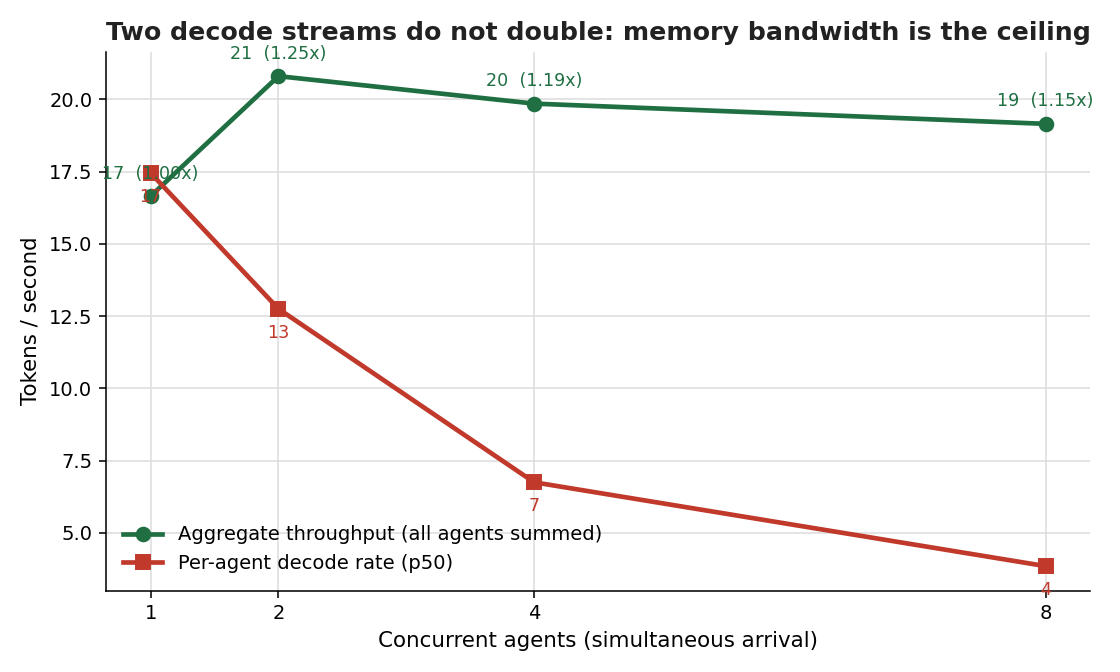
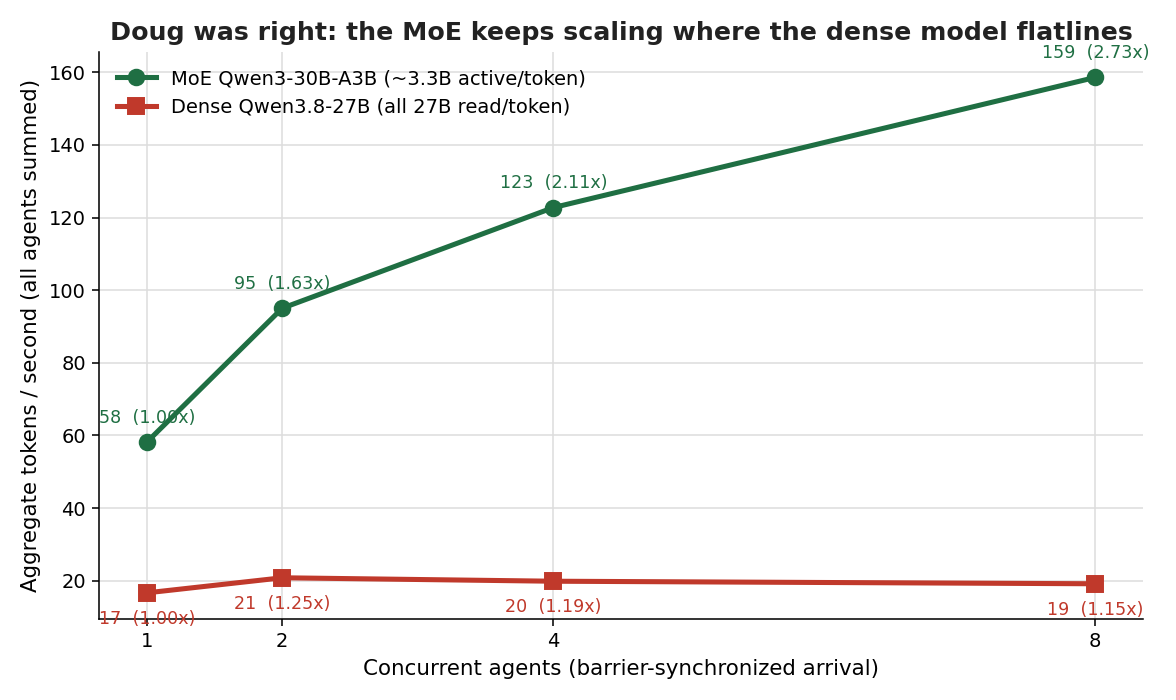
Reddit pushed back on my batching post with 3 sharp, testable claims: decode is memory-bandwidth-bound, prefill batches better than decode, and prompt length changes the whole story. So I built a measurement matrix, ran 36 barrier-synchronized loads against 1 local Qwen 3.8 on my Macbook Pro M3 Max, and let the numbers settle it. 2 of the 3 predictions held. 1 did not show up the way I expected, and I am keeping the correction in. Then a real agent handoff stalled on the exact wall these charts describe, and I show how a one-day-old runtime was already a first-class citizen in my receipts governance framework.

Fabian Williams

14-Minute Read

A line chart showing aggregate throughput flattening while per-agent decode rate collapses as concurrent agents rise from one to eight on one local MLX model

Over last week and these last 2 days in this week I posted measured answers to readers both in Twitter and Reddit who asked whether my experiments of 2 local agents on 1 Mac run in parallel or take turns. The answers was that they share one continuous batch, batching is real, and 3 quiet choices collapse it. I thought that was the end of it. It was not. The comments were better than my post, WHICH IS AWESOME, becaue this is the crowdsourcing of brain power I love. I not trying to be a KNOW IT…

Two Agents, One Local Model: Do They Run in Parallel, or Take Turns? I Measured It.

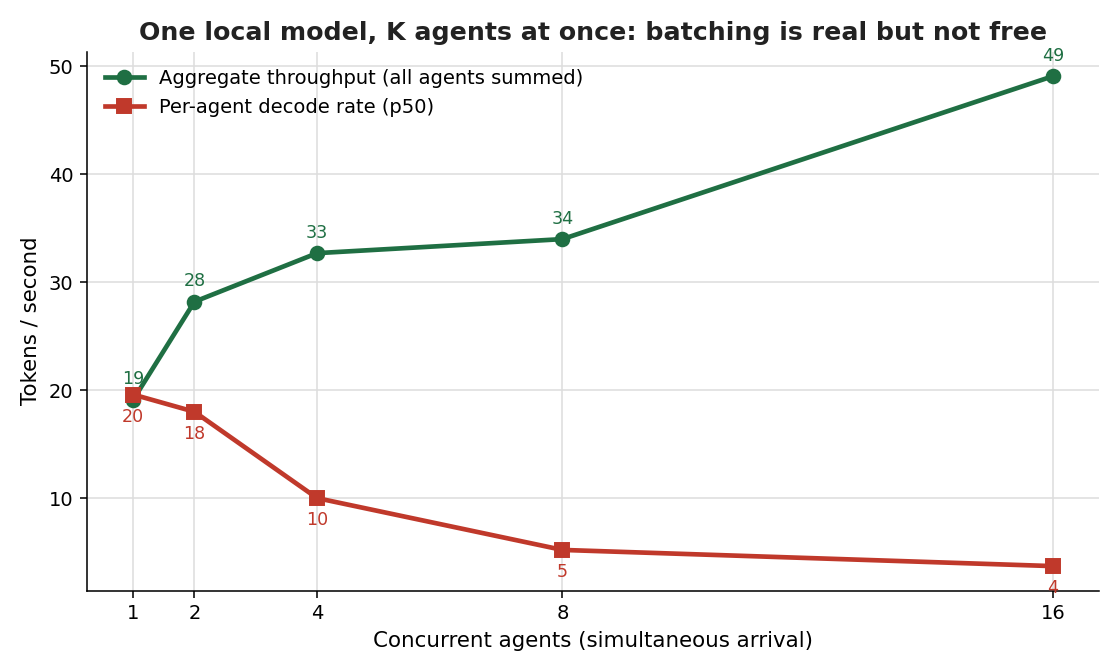
A reader asked what happens if I run two local coding agents against the same Qwen 3.8 model on one Mac at the same time. I thought I knew the answer. I was wrong. So I read the server source, wrote a barrier-synchronized load driver to remove the human-ordering bias, and measured it. Batching is real up to 32 wide, but it is not free, and three innocent-looking choices collapse it back to a single lane.

Fabian Williams

9-Minute Read

A line chart showing aggregate throughput rising with concurrent agents while per-agent decode rate falls, on one local MLX model

A reader on Reddit asked me a sharp question about my last post. I had trialed a second local coding agent, Hermes, pointed at the same local Qwen 3.8 model my other agent already uses. His question was simple. Did I ever run both agents at the same time, two separate harnesses hammering one model on one Mac at once. And what about Hermes spawning its own sub-agents against that same endpoint. Is any of that predictable.

Recent Posts

Categories

About

Fabian G. Williams aka Fabs Site