I Swapped My Local Coding Model Overnight From a Hotel. The Agent Graded the Upgrade Itself.
Local models are how I run my community work, my volunteer projects, my side hustles, and my musings, for two reasons: cost and keeping client data away from the labs. A new version dropped, so I upgraded it overnight from a hotel, additively, without touching the old one. Then I handed the new model the reviews and let my OpenCode agent test its own upgrade. It stood up a throwaway server, probed itself, and found three config gaps quietly throttling it. Here is the journey, in tables.
TL;DR
Local models are how I run my community work, my volunteer projects, my side hustles, and my musings. Two reasons, both simple:
- Cost. None of this work should bill against a frontier account.
- Trust. Client and customer data stays on my own disk, away from the labs.
Bottom line up front: I am running Qwen3.8-27B (4-bit) on my MacBook Pro M3 Max, 128 GB of unified memory and a 40-core GPU, my personal dev rig, driven by an OpenCode harness.
A new version, Qwen 3.8 27B, dropped this week. I was away from home, which is not a problem; it is a window. So I upgraded the model the only safe way when you cannot babysit it: additively. New model on its own server, on its own port. The old model left running, untouched, one keystroke away.
Then I handed the new model the reviews and asked my OpenCode agent to grade its own upgrade. It stood up a throwaway test server, probed itself, measured its own speed, read its own weight index, and found three config gaps quietly throttling it. It wrote its own runbook. I read that runbook and graded the work.
The model is good. The bigger result is the one worth keeping.
The engine is rented and swappable. The harness is what you own. Upgrade the engine additively, and let the harness prove the delta.
The Doubt Nobody Admits: The Upgrade Is the Risk
Everybody celebrates the new model. Almost nobody talks about the moment right after you click download. You rip out the version you trusted and drop in one you have never run, on the exact machine you depend on.
That is the real cost of a local model. A frontier model lives in someone else’s data center and you rent it. A local model lives on your disk. Every upgrade is open-heart surgery on a tool you actually use.
So the question is never “is the new model better.” The question is “how do I try the new model without betting the old one.” Those are very different questions.
Why Now: The Local Tier Does Real Work
For me this is not a benchmark hobby. The local tier does paying-adjacent work: nonprofit automations, volunteer builds, side projects, and the thinking-out-loud that turns into posts like this one. Cloud models are brilliant, but I do not want that class of work metered, and I do not want that class of data leaving my disk.
Here is what the new engine actually is. Not in three dense paragraphs, in one table.
| Property | Qwen 3.8 27B |
|---|---|
| Parameters | 27B dense |
| Architecture | Hybrid: 3⁄4 layers linear attention, 1⁄4 full attention |
| Why that matters | Runs quick, small KV cache, fits consumer hardware |
| Context window | 262K native (extendable to 1M) |
| Multimodal | Yes, native (text, image, video) |
| Tool calling | Yes |
| Design center | Agentic coding and long-horizon office work |
| License | Apache 2.0 |
And the headline numbers, which I want to label honestly. These are Qwen’s own model card, vendor numbers, not my independent finding. I repeat them as claims to be tested, not facts.
| Benchmark (per Qwen’s model card) | 3.8 27B | 3.6 27B |
|---|---|---|
| SWE-bench Pro (agentic coding) | 61.7 | 53.5 |
| CoWorkBench (long-horizon office) | 70.7 | 61.0 |
| OSWorld-Verified (computer use) | 84.3 | 63.9 |
| IFBench (instruction following) | 79.5 | 69.1 |
What I can vouch for is the speed I measured myself and the behavior my own agent verified. That is the rest of this post.
The Scar: Away From Home Is the Window, Not the Problem
I was at a hotel, away for a few days, working on my personal dev rig: the M3 Max with 128 GB of memory that I run all of this on. Not a work machine, my own rig, the one the community and volunteer projects live on, and it travels with me. That is not a dire setup. That is the opportunity.
Time away from the daily grind is exactly when I do the housekeeping I never otherwise reach: upskill, prune, evolve the dev rig, close out the things that have been sitting. Upgrading the local model was that kind of work. The 15 GB pull ran overnight on hotel wifi while I slept. Nothing was on fire. I had time.
The whole discipline is one move. The upgrade stands next to the old model, it does not replace it.
| Old (kept) | New (added) | |
|---|---|---|
| Model | Qwen 3.6 27B | Qwen 3.8 27B |
| Server port | 8080 | 8081 |
| Status | Untouched, still default | New, opt-in |
| To go back | It never left | Pick 3.6 in the dropdown |
If 3.8 had been a disaster, I lose nothing. I pick 3.6 and I am back. That is the entire point of additive.
Then I did the part I would not have trusted a year ago. I pointed my OpenCode agent, running the new 3.8 model, at the reviews and articles I had gathered, and I asked it to figure out what it actually was and whether it was configured correctly.
It did not summarize the reviews. It went and checked.
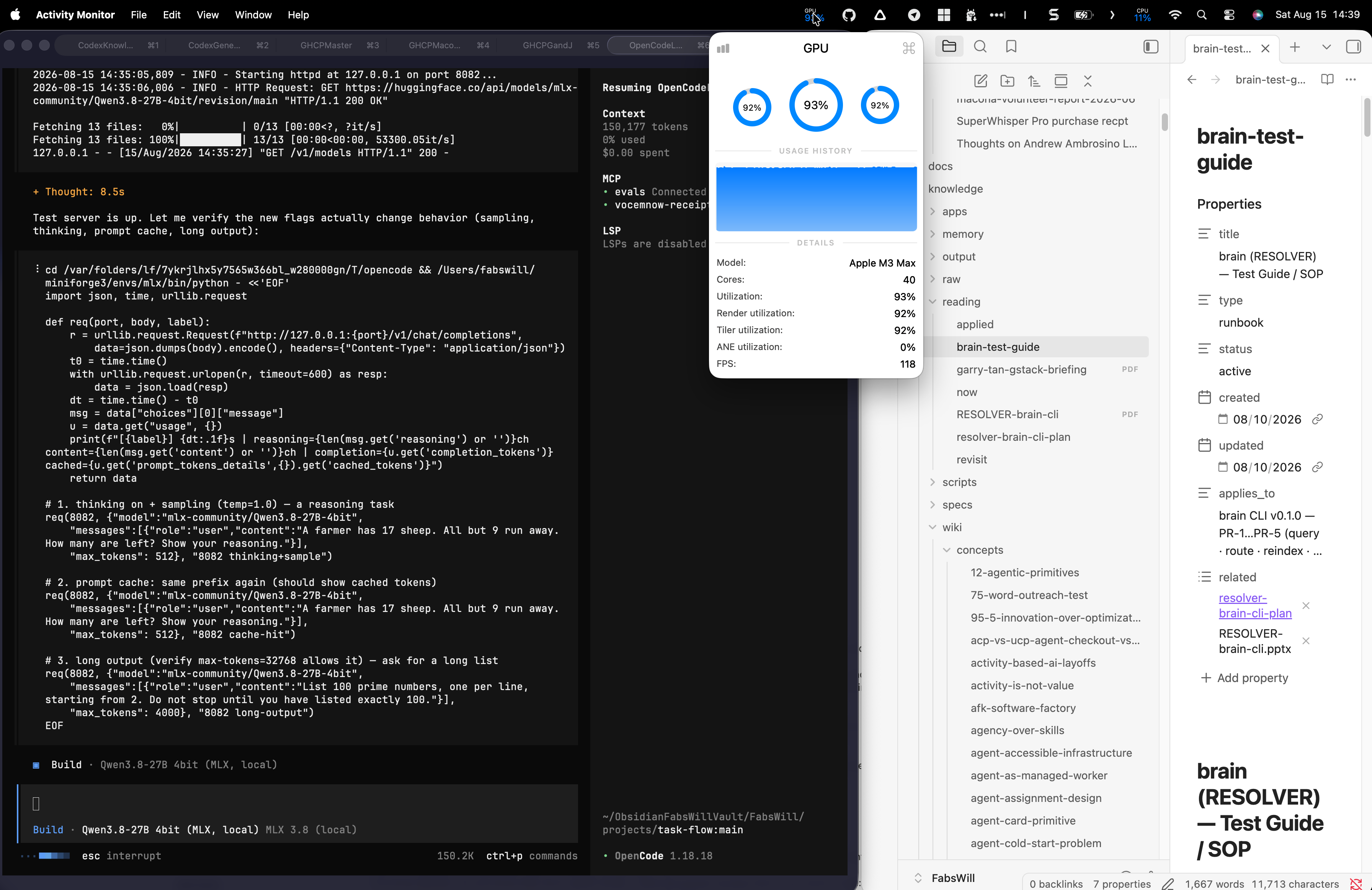
It stood up its own throwaway test server on a third port, 8082, so it would not disturb the one I was using. It fired controlled probes at itself. It watched the GPU climb to 92 percent under its own load. It measured its own decode speed firsthand instead of trusting a reviewer.
| Model | Decode (warm) | Decode (cold) |
|---|---|---|
| Qwen 3.8 27B (8081) | 20.2 tok/s | n/a (hot) |
| Qwen 3.6 27B (8080) | 12.2 tok/s | 3.5 tok/s |
That is 1.65 times faster warm, and the hybrid architecture is why. The agent also opened the model’s own weight index and noticed this 4-bit build has the multi-token-prediction weights stripped out, so one advertised speedup is simply not in this quant. A human skims past that. A model inspecting itself does not.
Then it delivered the finding that made the exercise worth it.
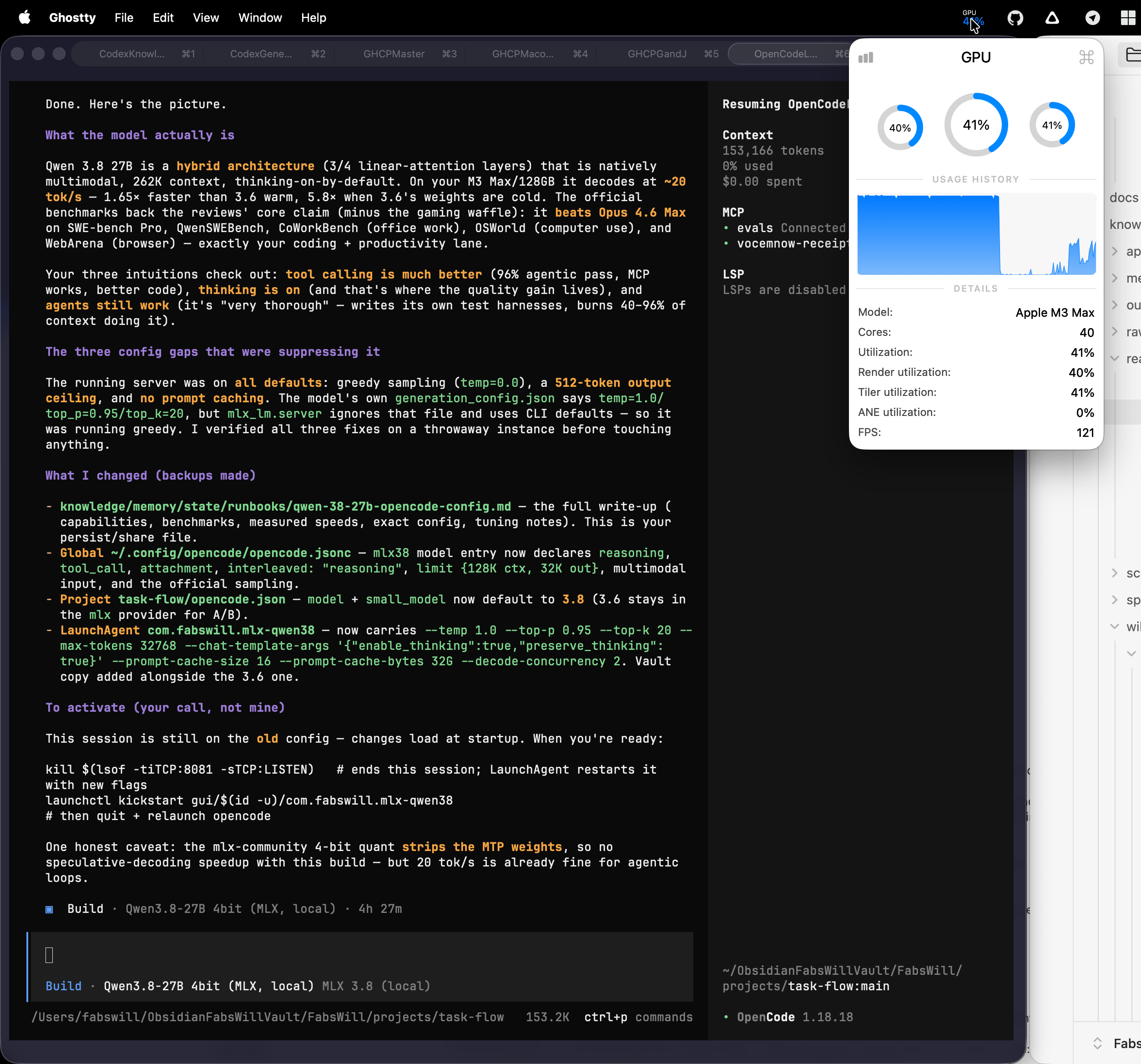
The new model was running throttled, and it diagnosed exactly why.
| Config gap | Effect | Root cause |
|---|---|---|
| Greedy sampling (temp 0) | Model runs rigid, not in the mode it was tuned for | The server reads request body, then a CLI default, and never reads the model’s own recommended settings file |
| 512-token output ceiling | Responses cut off short of an agentic answer | Server default, never raised |
| No prompt caching | Every turn re-processes the full system prompt and tools | Cache never enabled |
None of these are the model’s fault. They are the plumbing around it. And the model found them by testing itself.
What Changed: Own the Harness, Not the Engine
I asked the agent to write down what it learned, and it did: a runbook with the corrected server command, the exact sampling settings, the output ceiling, and the cache configuration. Then I reviewed that work the way I review any agent’s work. I will give the grade in public.
The good: it verified instead of asserting. It tested in a clean room rather than on the live server. It found a real root cause, not a symptom. It staged the fix behind backups, so nothing broke while I was away and could not babysit it.
The caveats, stated plainly: it repeated the vendor benchmark table with more confidence than vendor numbers earn, so I relabeled those as model-card claims. It nudged a project default over to the new model, which is a bigger posture change than a side-by-side trial. And the tuned config it wrote is staged, not yet live; the running server is still on the old conservative flags until the corrected launch file is applied.
So where I sit now: the new model is installed, on its own server, one click away, with the old model one click the other way. The corrected configuration is written down, waiting for the moment I am home and ready to apply it. And the record of how it was diagnosed was produced by the very agent whose model was under test.
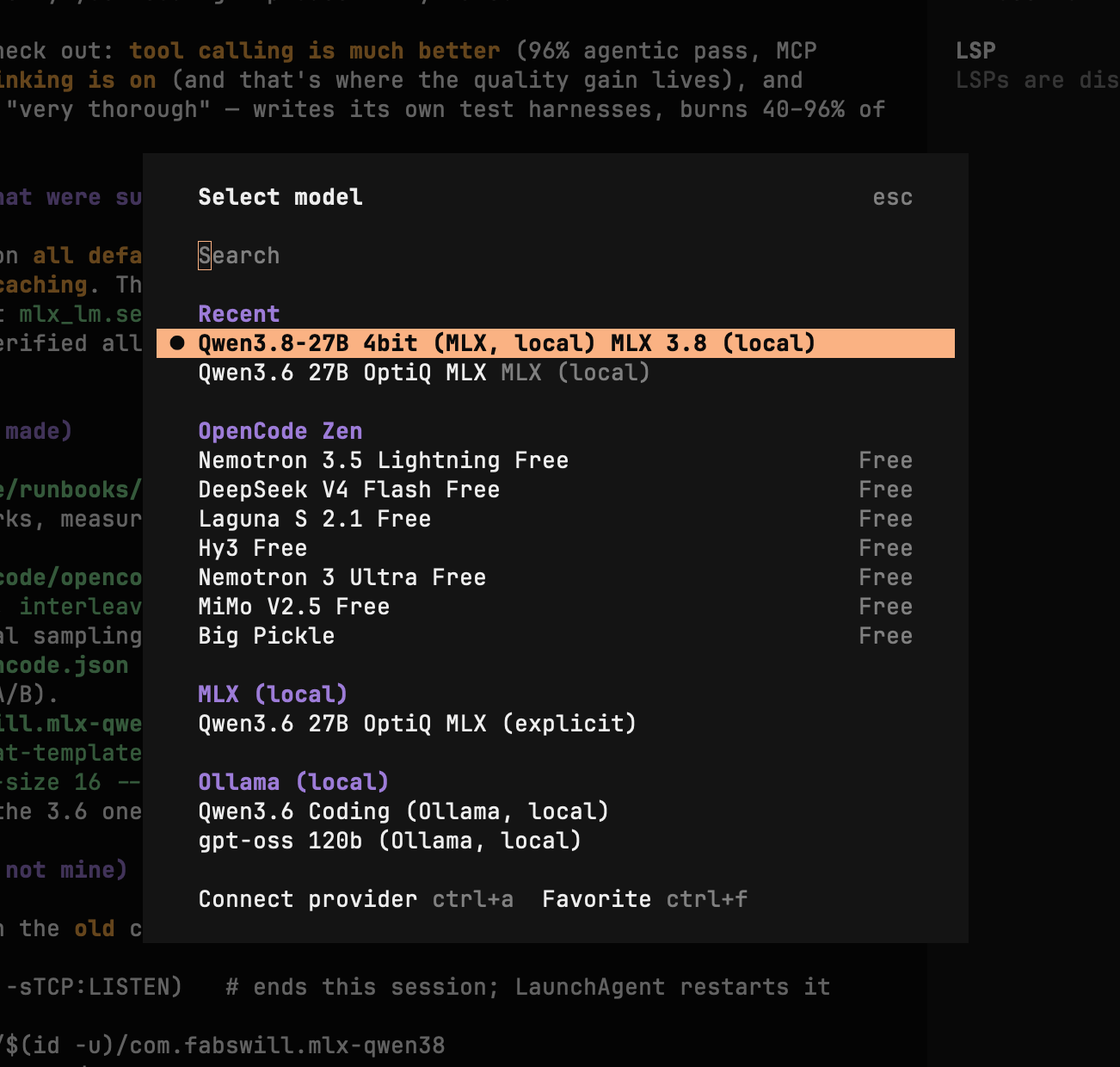
Here is the summary, and I do not want it buried at the bottom.
The engine changed overnight. The harness is what made the change safe. I would rather own the harness.
Garry Tan calls this staying under your own power. His framing for personal AI is a clean one: rent the intelligence, own the memory. The frontier model is a visitor. The durable layer is yours: your context, your skills, your recurring jobs, your permissions, your repo. YC’s related principle says the same thing about code: the software is disposable, the data and the intent are precious. Regenerate the tool when the models get smarter; preserve the thing that makes it yours.
A local model is the sharpest version of that idea. The engine on port 8081 is disposable. In a month there will be a faster one, and swapping it in is an afternoon. What is not disposable is the harness around it: the discipline that upgrades additively so the old model is always a keystroke away, and an agent I trust enough to hand a new version and say, “prove on real measurements whether this is any good, and whether it is even configured right.”
The frontier labs will keep shipping better engines. That is a tailwind, not a threat. The engine is rented. The power is in owning everything around it.