Fabian G. Williams aka Fabs

Fabian G. Williams

Principal Product Manager, Microsoft Subscribe to my YouTube.

Two Agents, One Local Model: Do They Run in Parallel, or Take Turns? I Measured It.

A reader asked what happens if I run two local coding agents against the same Qwen 3.8 model on one Mac at the same time. I thought I knew the answer. I was wrong. So I read the server source, wrote a barrier-synchronized load driver to remove the human-ordering bias, and measured it. Batching is real up to 32 wide, but it is not free, and three innocent-looking choices collapse it back to a single lane.

Fabian Williams

9-Minute Read

A line chart showing aggregate throughput rising with concurrent agents while per-agent decode rate falls, on one local MLX model

A reader on Reddit asked me a sharp question about my last post. I had trialed a second local coding agent, Hermes, pointed at the same local Qwen 3.8 model my other agent already uses. His question was simple. Did I ever run both agents at the same time, two separate harnesses hammering one model on one Mac at once. And what about Hermes spawning its own sub-agents against that same endpoint. Is any of that predictable.

I Swapped My Local Coding Model Overnight From a Hotel. The Agent Graded the Upgrade Itself.

Local models are how I run my community work, my volunteer projects, my side hustles, and my musings, for two reasons: cost and keeping client data away from the labs. A new version dropped, so I upgraded it overnight from a hotel, additively, without touching the old one. Then I handed the new model the reviews and let my OpenCode agent test its own upgrade. It stood up a throwaway server, probed itself, and found three config gaps quietly throttling it. Here is the journey, in tables.

Fabian Williams

8-Minute Read

Activity Monitor showing the M3 Max GPU pinned at 92 percent while an OpenCode agent runs probe requests against a throwaway Qwen3.8 test server on port 8082

Local models are how I run my community work, my volunteer projects, my side hustles, and my musings. Two reasons, both simple:

I Made My Evals Replay Every Task on a Local Model. The Frontier Lead Got Thin.

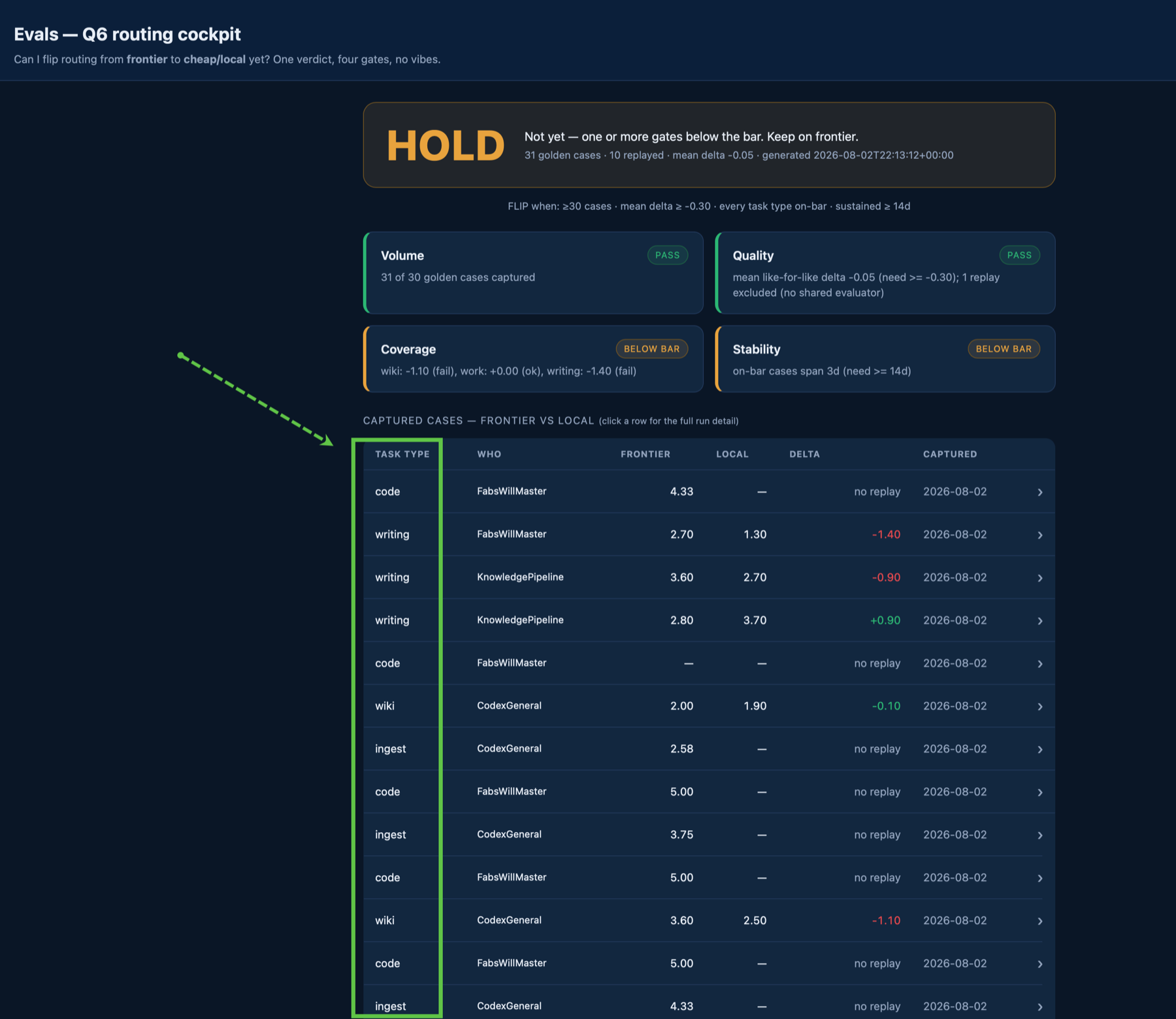
My agents run on frontier models, but a free local model sits idle on a Mac Mini in my office. So I wired my eval system to replay every writing task on the local model and grade both. Across 10 like-for-like rematches the local model reached statistical parity — and beat the frontier model outright on four of them. Here is the receipts-first system that made it prove it.

Fabian Williams

7-Minute Read

Eval cockpit showing the verdict panel: 31 golden cases, 10 replayed, mean like-for-like delta -0.05, with Volume and Quality gates passing

My agents do real work on frontier models. Every dollar of that work is metered against my OpenAI and Anthropic bills. Meanwhile a perfectly capable local model, gpt-oss:20b, sits on a Mac Mini in my office costing me nothing. The obvious question: for which tasks could the free local model do the job just as well?

Recent Posts

Categories

About

Fabian G. Williams aka Fabs Site